Full privacy slat fencing uses overlapping or tightly spaced slats so you cannot see through the fence. In Queensland, powder-coated aluminium is the usual choice for heat, UV and salt. Horizontal overlapping boards give the most privacy but can be climbable — do not use them as a pool barrier unless the design is certified compliant.
A slat fence that still shows the neighbour’s kitchen is not a privacy fence. It is a decorative screen with gaps.
This guide is for homeowners in Brisbane, the Gold Coast and the Sunshine Coast who want full privacy slat fencing — a solid-looking aluminium (or similar) run that blocks views, reduces overlooking, and still suits a modern house. It covers overlapping vs open slats, horizontal vs vertical, height and neighbour rules, why most “privacy slats” fail as pool fences, cost factors, and what to ask before you buy.
AMG Fabrication custom-makes metal privacy screens, slat-style fencing and gates as part of its fabrication services — design, manufacture and installation in one workshop. If you want the broader style overview first, read [modern slat fencing Brisbane], then use this article for the full privacy specification.
What full privacy slat fencing is (and is not)

“Slat fencing” covers a lot of products. Some are 20 mm gaps that look airy on Instagram and do almost nothing for overlooking. Full privacy means a person standing at normal height on the other side cannot get a clear view through the face of the fence.
That usually means one of these:
- Overlapping slats (often horizontal): each board covers the gap behind the one below, like weatherboards
- Tight vertical battens with almost no daylight, sometimes with a backing sheet
- Hit-and-miss that is closed up so the “miss” is a second layer, not an opening
It is not:
- Wide-spaced decorative slats
- A see-through screen you hope the hedge will fill
- Automatically a legal pool fence
Airflow and privacy trade off. A fully closed face blocks more wind, more noise, and more view. It also puts more load on posts in a Queensland storm. That is a footing and post-size decision, not a colour-chart decision.
For a balcony, patio or verandah where you need a shorter run rather than a boundary fence, a custom privacy screen or louvre panel can do the same job without rebuilding the whole side fence.
Horizontal vs vertical when you need real privacy
Both orientations can be full privacy. They fail in different ways.
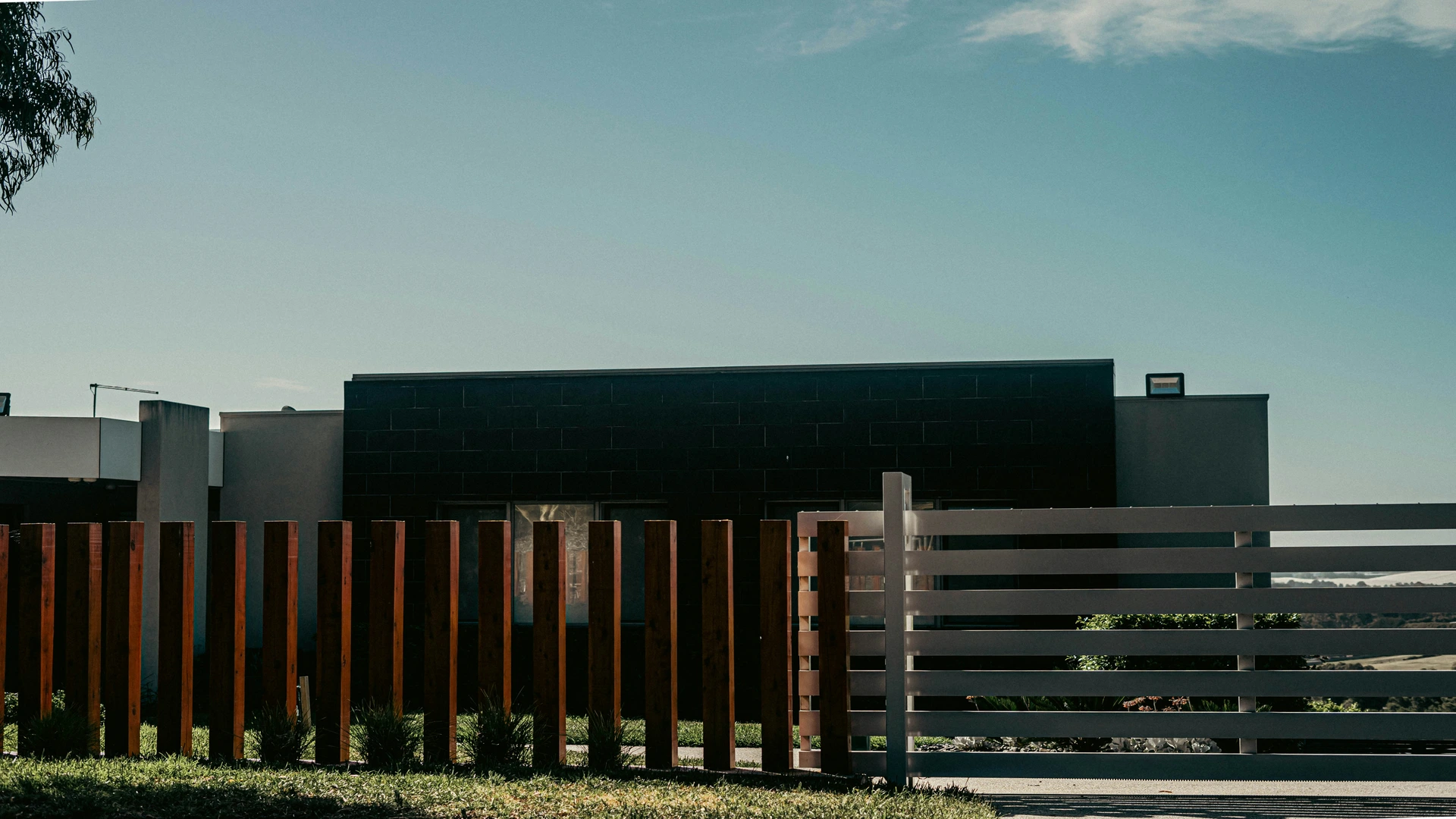
Horizontal overlapping is the usual “I don’t want to see them, and I don’t want them seeing us” spec. Ask for the overlap in millimetres, not “privacy grade” as a slogan.
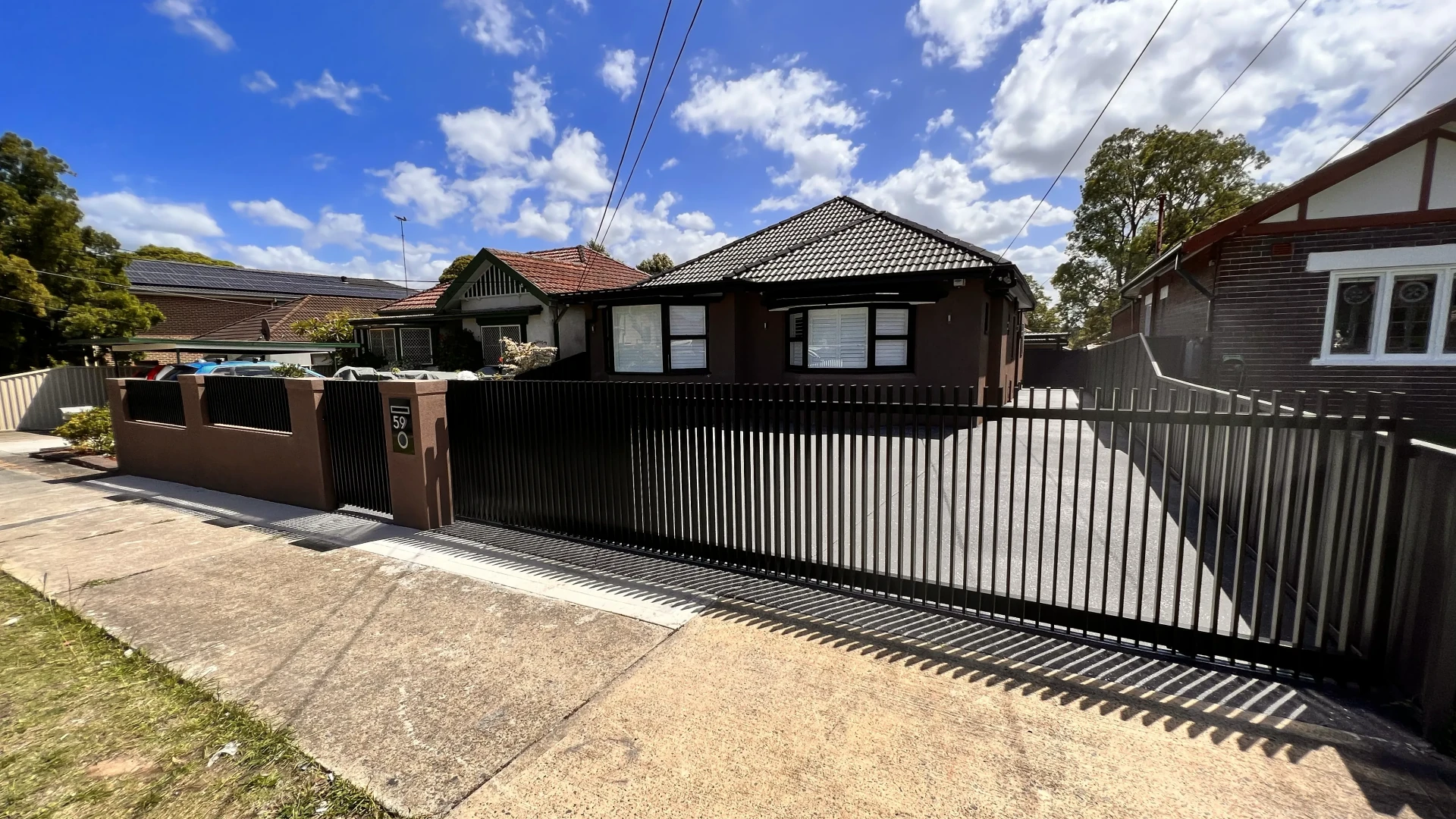
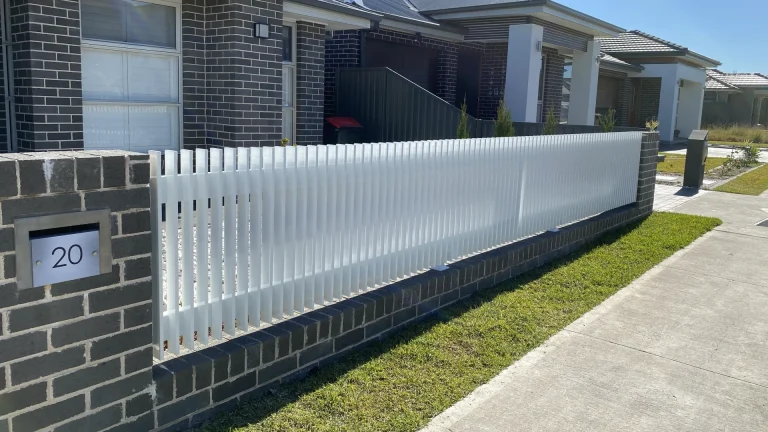
Vertical battens look sharper from the street and are less of a ladder, but cheap jobs still leave 15–20 mm slots that light — and sight lines — go straight through. Full privacy vertical work is almost a solid wall made of slats.
If the brief is “modern but I still want to chat over the fence”, you do not want full privacy. You want spaced slats. Say that out loud so you are not sold the wrong product.
Materials that last in Queensland
Powder-coated aluminium is the default for custom slat work here. It does not rust like steel, it holds colour, and it copes with Brisbane humidity and Gold Coast salt better than untreated timber. Thickness of the slat, the alloy, and the powder-coat system matter more than the colour name.
Timber-look aluminium (woodgrain powder coat) is popular where people want slats without oiling spotted gum every year. UV still chalks a cheap coat. North and west faces cop the worst of it.
Timber can look warm on day one. In Queensland it moves, greys, and needs sealing. Fine if you like that maintenance; a poor match if you chose slats to avoid painting.
Steel slats need a serious coating. Coastal salt finds cut edges and cheap screws.
Fixings are where good fences die. Mild-steel screws in aluminium frames stain and loosen. Specify compatible fasteners, capped posts, and a coat that wraps edges. AMG’s custom work is fabricated in-house so those details sit on the drawing, not in a hardware bag.
Height, neighbours and council (QLD, not guesswork)
A dividing fence is a legal object, not only a product.
Queensland’s dividing fence rules (opens in a new tab) sit under the Neighbourhood Disputes (Dividing Fences and Trees) Act 2011. In plain terms:
- Neighbours usually share the cost of a sufficient dividing fence
- For two residential blocks, “sufficient” is commonly 0.5–1.8 m high and built of ordinary fence materials (metal panels and rods are included)
- If you want something taller, fancier, or well above “sufficient”, you may be paying the extra yourself unless the neighbour agrees
- Do not attach things that damage a shared fence
That is a summary, not legal advice. Agreements should be in writing. QCAT deals with disputes when talks fail.
Council is a second filter. Brisbane City Council’s boundary fence page (opens in a new tab) notes that building approval is typically needed if the fence is more than 2 m above natural ground (height includes screens plus retaining), or if it forms part of fencing for a regulated pool. Planning overlays, character precincts, dual occupancy and new houses can add extra rules. Gold Coast and Sunshine Coast councils have their own planning schemes — check before you lock in a solid 1.8 m street fence.
Posts, retaining and a slat face stacked together are often taller than people think. Measure from natural ground, not from the top of last year’s garden bed.
Full privacy slats and pool safety do not automatically mix
This is the expensive mistake.
Queensland pool barriers must meet the state’s pool safety standard (QDC MP 3.4). Inspectors look for height (generally at least 1200 mm), small gaps, a non-climbable zone, and a self-closing, self-latching gate. QLD pool fence and barrier guidance (opens in a new tab) is the homeowner starting point. Rules can change; a licensed pool safety inspector certifies.
Horizontal overlapping slats are often climbable. That is the opposite of a non-climbable pool barrier. Vertical slats with illegal gaps fail for a different reason.
Use full privacy slats for the neighbour boundary or the entertaining edge. Use a purpose-designed pool barrier — glass or compliant aluminium — for the water. If one fence must do both jobs, it has to be designed and certified as a pool barrier, not “privacy slats that look about 1.2 m”.
Cost factors (South East Queensland estimates)
AMG does not publish a single slat rate. Geometry, height and the overlapping detail dominate. These 2026 SEQ estimates are for budgeting only. Slope, rock, demolition, retaining, gates and access will move the figure.
Open decorative aluminium slats – Often lower than full privacy, roughly $150–$280 per lineal metre
Full privacy overlapping aluminium slats – Often about $180–$400 per lineal metre
Matching pedestrian or driveway slat gate – Priced per leaf; automation is extra
Typical 20–30 m side/rear run, 1.8 m, overlapping, one gate – Commonly several thousand dollars into the low tens of thousands, depending on site
You are paying for posts and footings as much as for pretty boards. A closed face in a storm is a sail. Undersized posts on a full-privacy run are how fences lean after the first summer.
Ask whether the quote is supply-only or supply and install, and whether measure and fabrication are included.
Maintenance in heat, UV and salt
- Wash powder coat with mild soapy water a few times a year; more often near the beach
- Rinse after storms so salt does not sit in slots and end caps
- Keep garden beds and soil off the bottom rail so you do not bury the fence and invite corrosion at the posts
- Check screws, gate hinges and drop-bolts after the wet season
- Touch up chips so UV does not chalk a raw edge
- Do not lean timber, bins or a trampoline against overlapping horizontals if kids could climb them — even when it is not a pool fence
AMG’s fabrication includes a 3-year product warranty and defect rectification on the work supplied. Long-term colour still depends on the coat system and washing.
What to check before you buy
Can I see through a sample panel at 2 m? If yes, it is not full privacy.
Overlap or gap size in millimetres? Get it on the quote.
Horizontal or vertical — and is anyone using this as a pool barrier? If yes, stop and redesign.
Height from natural ground, including any retaining? Over 2 m in Brisbane often means building approval.
Dividing fence or your fence inside the boundary? Neighbour contribution rules differ.
Post size, footing depth, wind? Especially on corners and gates.
Powder coat system and screw spec? No mild steel in aluminium.
Who measures, fabricates and installs? One workshop is simpler when a gate does not match the bay widths.
If the quote only says “aluminium slat fence” with no overlap, height or post spec, you are not comparing like with like.
Which spec should you choose?
Choose overlapping horizontal aluminium if overlooking is the whole problem and the run is a side or rear boundary — not a pool barrier.
Choose tight vertical battens if you want full privacy with a more “architectural” face and less of a ladder.
Choose a privacy screen or louvres on the deck or balcony if you only need to block one sight line.
Choose open slats only if breeze and look matter more than being unseen.
Full privacy is a closed face. Treat it like a small wall: structure first, colour second.
Frequently asked questions
What is full privacy slat fencing?
It is slat fencing specified so you cannot see through it — usually overlapping boards or very tight battens. Spaced decorative slats are a different product, even if they use the same word “slat”.
How much does aluminium slat fencing cost in Brisbane?
Open slat runs often sit lower; full-privacy overlapping aluminium in SEQ commonly lands around $180–$400 per lineal metre installed, depending on height, thickness, gates and site. These are estimates only. A measure is the real price.
Is horizontal or vertical better for privacy?
Horizontal overlapping usually hides views more easily. Vertical can equal it if gaps are tiny or the slats are backed. Horizontal is more climbable, which matters next to a pool or a low roof.
Can slat fencing be used as a pool fence in Queensland?
Only if the whole barrier — height, gaps, non-climbable zone and gate — meets current QLD pool safety rules and passes inspection. Most overlapping horizontal privacy fences will not. Do not assume.
Do I need my neighbour’s agreement?
For a dividing fence on the boundary, Queensland law generally expects neighbours to share a sufficient fence. A premium full-privacy aluminium design may cost more than “sufficient”; talk before you build. This is not legal advice.
Do I need council approval for a 1.8 m slat fence in Brisbane?
Often a standard residential dividing fence under 2 m does not need building approval, but overlays, character areas, retaining, and pool barriers change that. Check Brisbane City Council (opens in a new tab) or your Gold Coast / Sunshine Coast council. When in doubt, ask a certifier.
Will aluminium slats fade in Queensland sun?
A proper powder coat holds colour for years; cheap coats chalk, especially on north and west faces. Washing and the right spec matter more than the brochure photo.
Conclusion
Full privacy slat fencing is a specification: overlap or near-zero gaps, the right height, posts that can take wind, and a clear decision that this run is not a pool barrier unless it is designed as one. Powder-coated aluminium is the practical Queensland material. Horizontal overlapping blocks views; vertical tight battens climb less.
Measure from natural ground, talk to the neighbour if it is a dividing fence, and get millimetres on the quote.
AMG Fabrication can design, fabricate and install custom slat-style fencing, gates and privacy screens across Brisbane, the Gold Coast and the Sunshine Coast. Book a free consultation and obligation-free quote via the contact page.