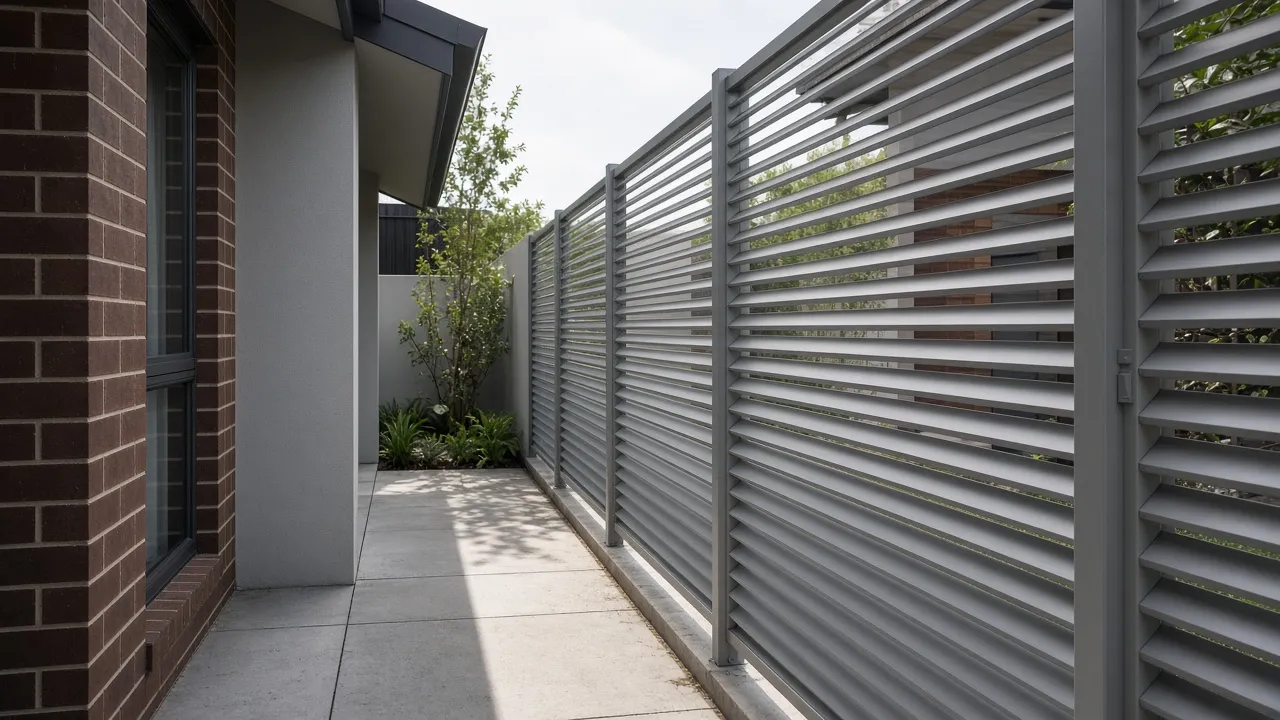
For tight side paths, louvres keep more light and airflow while breaking the view. Privacy screens block overlooking harder and can feel darker and stiller in a narrow setback. Choose louvres when the path already feels like a tunnel. Choose a denser screen when the neighbour’s window owns the walkway.
Narrow side access is one of the most awkward privacy problems on Brisbane blocks. You need to walk bins through. You want some daylight. You do not want eye contact with the kitchen next door every time you take the recycling out.
This guide compares louvres vs privacy screens for tight side paths — what each does with light, breeze, privacy, wind load and maintenance — so you pick the right panel before you block the only air the path gets. AMG Fabrication custom-makes louvres, privacy screens and related metalwork across Brisbane, the Gold Coast and the Sunshine Coast.
If you need a full boundary run rather than a short path fix, start with aluminium slat fencing Brisbane or full privacy slat fencing. This post stays on the skinny side setback.
On Reddit, Brisbane homeowners often ask how to stop overlooking without turning the side path into a black corridor. That is exactly this decision.
Louvres are angled blades — usually aluminium, sometimes timber — fixed in a frame. The blade angle controls how much you can see through and how much light and air pass. Fixed louvres are set at one angle. Adjustable louvres can change with season or time of day, though side-path installs are often fixed for simplicity and cost.
Privacy screens here means a denser custom panel: overlapping or tight aluminium slats, a solid-face metal screen, or frosted glass in a frame. The job is to stop a clear sight line. Airflow and light drop as privacy rises.
Both can be powder-coated to match windows or fascia. Both can be sized to one ugly window, a gate return, or the full length of the path. Neither is automatically a pool barrier or a fall balustrade. If the path edge is also a drop, that is a separate balustrade conversation.
A side path between two houses is not a wide backyard fence line.
Light is limited. A solid screen can make midday feel like evening. Airflow is limited. A fully closed face can trap heat and damp between brick walls. Access still matters for bins, air-con units, meters and trades. Fixings often go to masonry, timber paling, or freestanding posts in a skinny strip of ground. Wind can funnel down the gap in storms, so a closed sail needs proper posts and brackets.
That is why “maximum privacy” is not always the smartest first choice in a 900–1200 mm setback. Sometimes filtered privacy is the difference between a usable path and a mouldy alley.
Choose louvres when:
Fixed aluminium louvres are the practical Queensland default: low maintenance, colourable, and stable in humidity. Timber louvres look warm but need more sealing and move more in heat.
Set the blade angle for the actual overlooking problem. Blades aimed to block a second-storey window are not the same as blades aimed to block a ground-floor kitchen. A site measure beats a catalogue angle.
Choose a denser privacy screen when:
Overlapping aluminium slats or tight vertical battens give strong privacy. Frosted glass keeps more light while blurring detail, but needs cleaning and can show water spots in dusty side setbacks. A solid metal face is the hardest privacy stop and the most tunnel-like.
For broader privacy benefits beyond side paths, see privacy screens Brisbane.
This is the heart of louvres vs privacy screens for tight side paths.
Louvres trade a little visibility for daylight and air. You may still see movement through gaps at the wrong angle, especially at night with strong interior lighting next door. Privacy screens trade light and air for a harder visual stop. In a narrow path, that can feel safer socially and worse environmentally — hotter, darker, stiller.
A hybrid often works best: denser screen where the window lines up, louvres on the rest of the run so the path can breathe. That is custom fabrication, not a one-panel catalogue answer.
Powder-coated aluminium is the usual winner: no rust, colour range, easy wash-down. Side paths collect leaf litter, splash from storms, and sometimes salt in bayside suburbs. Mild-steel screws in aluminium frames stain and loosen — specify compatible fasteners.
Timber needs more care between two walls where sun and damp alternate. Glass screens need space to clean; a 900 mm path makes that annoying fast.
Posts and brackets must match wind load. A closed privacy screen in a wind corridor is a small sail. Undersized fixings into old paling or soft mortar are how screens lean after the first summer storm.
AMG’s custom work includes design, fabrication and installation, with a 3-year product warranty and defect rectification on the fabrication supplied.
These are 2026 SEQ estimates for budgeting only. Height, length, fixings, access and finish move the figure.
A short custom aluminium louvre or privacy panel for a side path often lands from roughly $800–$3,500+ depending on size. Larger runs are often priced more like screening per square metre or by lineal metre for fence-like frames — commonly somewhere in a broad $150–$400+ per square metre style band for custom aluminium work, with denser full-privacy and complex frames higher.
What changes cost:
A site measure matters more here than on an open backyard fence. Bin clearance, meter boxes and hose taps all steal millimetres.
A screen on your own structure or inside your boundary is different from rebuilding a dividing fence. If the work sits on the boundary, Queensland dividing-fence rules and neighbour contribution can apply — see QLD fence owner guidance (opens in a new tab). This is not legal advice.
Brisbane City Council boundary fence information (opens in a new tab) notes building approval can be needed over 2 m above natural ground, or where fencing forms part of a regulated pool barrier. Height includes combined screens and retaining. Check overlays and street-front rules before you build a tall solid face.
Do not use a side-path privacy screen as a pool barrier unless it is designed and certified as one. QLD pool barriers need height, gaps, non-climbable zones and a self-closing gate — see QLD pool fences and barriers (opens in a new tab). Horizontal privacy boards are often climbable. Rules can change; a licensed inspector certifies.
If the path sits beside a raised deck edge, privacy and fall protection are different jobs. You may need a compliant balustrade plus a screen, not one panel pretending to be both.
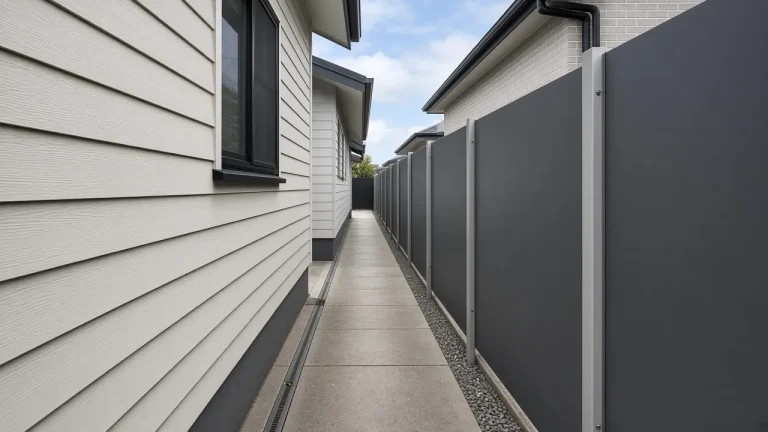
Choose louvres when light and airflow matter as much as manners with the neighbour.
Choose a privacy screen when stopping the view is the whole job and the path still gets light from both ends.
Choose a hybrid when one window is the problem and the rest of the path needs to breathe.
Choose a full slat fence when the entire boundary — not just the path — needs privacy.
If the quote only says “privacy panel” with no blade angle, gap or thickness, you are not comparing like with like.
Are louvres or privacy screens better for side paths?
Louvres are usually better when the path is dark and stuffy. Privacy screens are better when overlooking is severe and you need a hard visual block.
Will louvres stop the neighbour seeing in completely?
Not always. They break and angle the view. At some heights and lighting conditions, silhouettes can still read. For near-zero see-through, use overlapping screens or frosted glass.
Do privacy screens make side paths hotter?
A solid or overlapping face can reduce breeze and hold heat between walls. In Brisbane summer, that matters. Louvres or a hybrid run reduce that risk.
How much do custom side-path screens cost in Brisbane?
Short runs often start in the high hundreds to a few thousand dollars installed. Longer or full-privacy custom aluminium work costs more. Site measure only for a real figure.
Can I install a screen on the boundary fence?
Sometimes, with the right structure and neighbour agreement. Attaching heavy screens to a shared dividing fence can cause disputes or damage. Confirm ownership, structure and rules first.
Does AMG Fabrication make both louvres and privacy screens?
Yes. AMG custom-makes louvres, privacy screens, slat-style panels and related metalwork, with free consultation and obligation-free quotes across Brisbane, the Gold Coast and the Sunshine Coast.
Louvres vs privacy screens for tight side paths is a light-and-air decision as much as a privacy decision. Louvres keep the path usable. Denser screens stop the stare. Many Brisbane homes need both on the same run. Spec the sight line, the walkway clearance and the fixings — then fabricate to that, not to a generic “privacy” label.
AMG Fabrication can measure on site, fabricate louvres or privacy screens to your side path, and install across Brisbane, the Gold Coast and the Sunshine Coast. Book a free consultation and quote via the contact page.